Architecture and operation
A civic infrastructure augmented by artificial intelligence
HumaniaQC could be based on an open software architecture in which artificial intelligence acts as an analytical interface between public data and citizens.
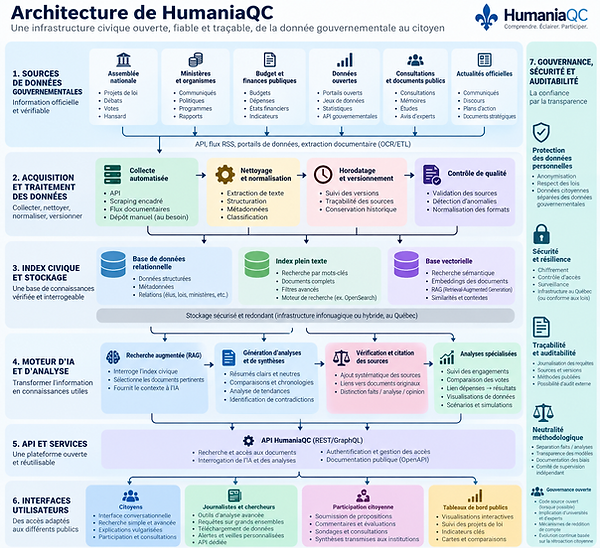
A first layer of data acquisition and synchronization would automatically collect information from official sources—National Assembly, bills, parliamentary debates, votes, budgets, open data, government departments, public bodies, consultations, and press releases—using APIs, structured feeds, and, where necessary, document extraction systems. This information would be standardized, time-stamped, versioned, and stored with its provenance so that each statement could be linked back to its primary source.
A second layer would constitute a civic index combining a relational database, a full-text search engine, and a vector database enabling RAG (Retrieval-Augmented Generation) semantic search. The AI would therefore not need to arbitrarily "know" government action: it would first search for relevant documents within this verified corpus, then produce summaries, comparisons, timelines, and analyses, systematically citing the elements on which its response is based. Above this infrastructure, a public HumaniaQC API could simultaneously power the website, a conversational interface for citizens, dashboards, consultation and survey tools, as well as an advanced space for journalists and researchers to query large sets of political decisions and public data. An analysis engine could, in particular, detect amendments to bills, compare commitments with actual decisions, track elected officials' votes, link public spending to measurable indicators, or present the main opposing arguments surrounding a policy.
Finally, a citizen participation layer would allow users to submit proposals, comment on or evaluate projects, participate in structured consultations, and potentially transmit aggregated summaries to public institutions. The entire system should be designed around principles of traceability, methodological neutrality, privacy protection, and auditability: explicit separation between facts, inferences, and opinions; access to quotations down to the original document; publication of classification and synthesis methods; logging of transformations performed by AI; anonymization of citizen data; and the possibility for researchers or journalists to audit the system's operation. The goal is therefore not to entrust democracy to AI, but to build a verifiable civic intelligence layer between the state and the population, capable of transforming a considerable amount of government information into accessible, questionable, and debatable knowledge.
Download the diagram below